Karbook Electricity Incident Raises Serious Questions Over Safety Protocols and Accountability
 NETB24
Karbook, Gomati, Tripura | August 8: A serious electrical accident at Bairagi Dukan, near Goria Mission School in Karbook Sub-Division, on the night of August 6, has raised significant questions over electrical safety procedures, communication between officials and accountability within the Electricity Department.
According to information gathered from local sources, nearly eight Electricity Department personnel, including senior and junior officials and line staff, were engaged in emergency restoration work after heavy rainfall and strong winds caused trees to fall on electricity infrastructure at several locations.
The incident occurred at approximately 10:30 PM on Thursday, August 6, when electricity was reportedly restored or energised while workers were still engaged in clearing and repairing a damaged line. One worker, Dharmendra Tripura, reportedly suffered a severe electric shock and became critically ill. Other personnel were also reportedly affected.
How the Incident Unfolded
According to information available from sources familiar with the incident, heavy rainfall on the night of August 5 caused trees to fall on electricity poles and lines at multiple locations in and around the Karbook Sub-Division.
The Electricity Department's line staff reportedly began restoration and line-clearing work from around 11 AM and continued through the afternoon.
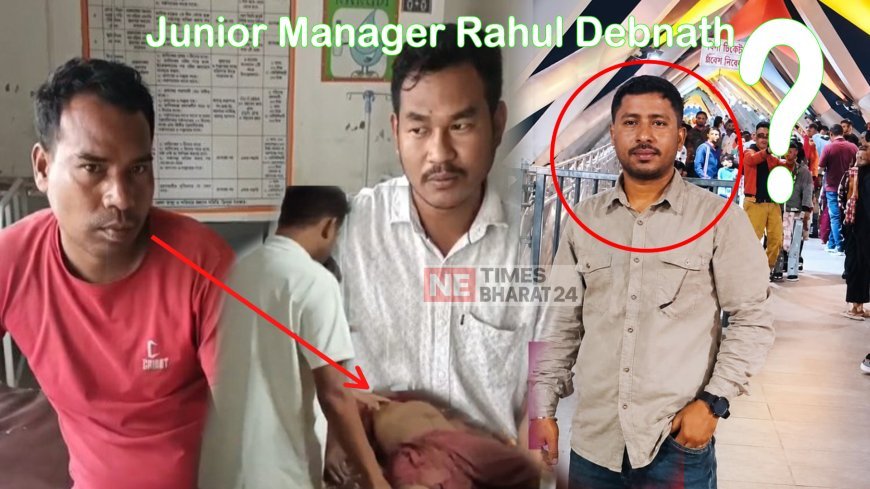
Sources said that the line shutdown/pass system was initially under Junior Manager Rahul Debnath, who is reportedly from the Matabari area of Udaipur.
Later, at around 8 PM, the responsibility was reportedly handed over to Senior Manager Stiffan Jamatia. According to the information received, Senior Manager Jamatia subsequently went to the Bairagi Dukan–Goria Mission School area at around 8:30 PM, where departmental personnel were continuing the restoration work.
The work continued late into the night.
At approximately 10:25 PM, when the team was reportedly close to completing the line-clearing operation, several workers were engaged in pulling and clearing electrical wires. Sources said Dharmendra Tripura was tying or handling an electrical wire, while Senior Manager Stiffan Jamatia was using a torch to assist the workers in the darkness.
It was during this stage that the electrical line was reportedly energised, resulting in the serious electric shock incident.
Conflicting Accounts Over the Permission to Energise the Line
One of the most serious questions surrounding the incident concerns who authorised the control room to energise the line while workers were still present at the site.
According to information attributed to departmental sources, Amrita Sadhan Jamatia, who was reportedly associated with the control-room operation, stated that an instruction to energise/control the line had been received from Junior Manager Rahul Debnath.
However, according to the statement attributed to Rahul Debnath, he had allegedly instructed the control room that the line should be made clear only after confirming with Senior Manager Stiffan Jamatia.
This creates a major discrepancy that requires an impartial departmental investigation.
Questions have also reportedly been raised about whether a telephone call was made between the concerned officials before the line was energised. Sources claim that no corresponding call record has so far been produced to establish such a confirmation, although this should be verified officially through call records, control-room logs and departmental documents.
Dharmendra Tripura's Condition Became Critical
Following the electric shock, Dharmendra Tripura reportedly became critically unresponsive.
At that time, social workers Banu Debbarma, Ajiram Reang and Tapan Debbarma, who were reportedly returning from Agartala, came to the aid of the injured worker.
According to information received, they transported Dharmendra Tripura towards Karbook Sub-Divisional Hospital, reportedly providing CPR and emergency assistance during the journey.
Sources said that Dharmendra began showing some signs of response after CPR was administered.
The incident has nevertheless raised concerns about whether adequate emergency medical and safety arrangements were available for workers engaged in dangerous nighttime electrical restoration operations.
Questions Raised About Departmental Responsibility
The incident has also triggered questions about the chain of command within the Electricity Department.
If a line is being repaired and workers are physically present on the site, who has the final authority to confirm that the line is safe for energisation?
Was the line-clearance/pass procedure properly followed?
Was the control room given a written or recorded confirmation?
Was the senior officer at the work site contacted before energisation?
Were all workers accounted for before the power supply was restored?
These are critical questions because even a small communication failure during high-voltage electrical work can have fatal consequences.
Previous Safety Concerns Also Need Investigation
There are also allegations of an earlier electrical safety incident involving BSF personnel in the Karbook area.
According to information provided by local sources, a few months ago the BSF had reportedly requested the Electricity Department to disconnect an 11 kV line so that work could be carried out on border lighting.
Sources allege that the required disconnection may not have been carried out properly before the BSF personnel began the repair work, resulting in an electric-shock incident.
This allegation has not been independently verified and should be investigated by the competent authority.
If confirmed, however, such an incident would raise additional concerns about compliance with electrical safety procedures and communication between the Electricity Department and other agencies.
Allegations Against Junior Manager Need Official Investigation
There are also allegations from local sources questioning the conduct and supervision of Junior Manager Rahul Debnath.
Some sources allege that departmental personnel had previously raised concerns about his approach to safety and staff management. However, these are allegations and should not be treated as established facts unless supported by an official inquiry or documentary evidence.
The most serious issue is not an individual's reputation but whether established safety procedures were followed.
If the investigation establishes that an officer knowingly authorised energisation without obtaining the required clearance from workers at the site, appropriate departmental and legal action should follow.
Similarly, if the investigation establishes that the required procedure was followed and the incident resulted from an unforeseen communication or technical failure, responsibility should be determined on the basis of evidence rather than speculation.
DGM Visits Karbook
The following morning, DGM Amarpur Sankar Majumder reportedly visited Karbook and met the injured worker, Dharmendra Tripura.
The visit indicates the seriousness with which the department is treating the incident.
However, local residents and departmental workers are now seeking a transparent investigation into the entire sequence of events, including the shutdown/pass system, control-room instructions, communication records, work-site clearance and the exact circumstances under which electricity was restored.
Who Will Take Responsibility If a Worker Loses His Life?
The incident has raised a fundamental question for the Electricity Department:
If eight personnel were working together at a dangerous site and something fatal had happened, who would have taken responsibility for the lives of those workers and the future of their families?
Electrical restoration work is inherently dangerous and requires strict coordination between the field team, senior officers and the control room. A single mistake can result in death within seconds.
The Karbook incident should therefore not be treated merely as an unfortunate accident.
It should become an opportunity for the department to examine whether its safety protocols, shutdown procedures, communication systems and supervisory mechanisms are actually being followed on the ground.
Demand for a High-Level Inquiry
Given the seriousness of the allegations and the conflicting accounts regarding the authorisation to energise the line, a formal and impartial departmental inquiry appears necessary.
The investigation should examine:
- The official shutdown/pass records.
- Control-room logbooks and switching records.
- Telephone communication between the concerned officers.
- The identity and statements of all personnel present at the site.
- The exact time at which the line was energised.
- Whether the required line-clearance procedure was followed.
- Whether the senior manager at the site had given clearance.
- Previous safety complaints or incidents involving the concerned officers.
- Whether adequate safety equipment and emergency arrangements were available.
Only a transparent investigation can establish what actually happened and who, if anyone, was responsible.
For now, the central question remains:
How was electricity energised while departmental personnel were reportedly still working on the line—and who gave the final clearance?
The answer could be crucial not only for the injured workers and their families but also for preventing another potentially fatal incident in the future.